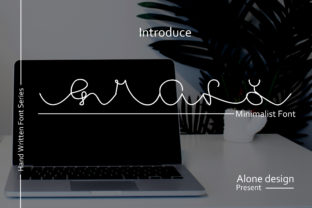
Grasy Handwritten Font for Crafters & Small Shops
As someone who designs printable wall art, prints labels for small-batch candles, cuts vinyl stickers for local boutiques, and builds digital templates for Etsy—finding a script font that feels personal *and* performs reliably is rare. That’s why Grasy has quickly become my go-to Script Handwritten typeface. It’s not overly ornate or stiff—it’s fresh, casual, and carries a smooth, effortless rhythm that reads like handwriting you’d actually want to keep in your kitchen drawer.
What makes Grasy stand out isn’t just charm—it’s practicality. The letterforms have gentle contrast, open counters, and consistent spacing, so even at 12–16 pt sizes (think jar labels, gift tags, or planner headers), it stays legible without losing its handwritten soul. I’ve used it for laser-cut wood signs with zero tracking issues, printed it on kraft sticker paper for artisan soap labels, and embedded it into SVG files for Cricut users—and every time, the curves hold up beautifully during cutting and scaling.
For physical product makers, Grasy works especially well where authenticity matters: handmade greeting cards, boutique clothing tags, wedding welcome boards, seasonal mug wraps, and farmhouse-style wall decals. Its relaxed flow gives warmth without looking dated or overly cursive—so it fits modern cottagecore branding just as easily as minimalist stationery lines. I recently designed a set of printable baby shower invitations using Grasy for the names and date, paired with a clean sans serif for details—and customers consistently commented how “inviting” and “thoughtful” the typography felt.
It shines brightest in display roles: titles on planner covers, headlines on digital printables, quotes on framed art prints, and short phrases on tote bags or ceramic mugs. Because Grasy is designed as a display font—not meant for long paragraphs—it keeps focus where it belongs: on names, dates, slogans, and key emotional words. You’ll want to avoid body text, but for anything under 10 words? It delivers clarity and character in equal measure.
Readability across production methods is where Grasy proves its craft-savvy design. On small round stickers (think 1.5" diameter), I use it at 14 pt with slight letter-spacing adjustment—no clipping, no tangled joins. For heat-transfer vinyl on t-shirts, I convert outlines first and keep stroke weight minimal; the smooth curves cut cleanly on Silhouette Cameo and Cricut Maker machines. And when prepping mockups for Etsy listings, Grasy renders crisply in PNG previews—even on mobile thumbnails—so customers instantly grasp the tone of your brand.
Font pairing is intuitive. I almost always pair Grasy with a neutral sans serif like Montserrat, Inter, or Poppins for contrast and balance—especially in packaging or multi-element templates. For wedding suites or vintage-inspired labels, a subtle serif like Lora or Playfair Display adds quiet elegance without competing. The key is letting Grasy breathe: use it for one focal element per layout (a name, title, or tagline), then anchor it with something highly legible and structurally grounded.
Grasy comes with standard OpenType features—including stylistic alternates and basic ligatures—that let you swap in more playful versions of letters like “&”, “f”, or “t” for added visual interest. While it doesn’t include extensive multilingual support, it covers full Latin-1 (including accented characters common in English, Spanish, French, and German), which covers most small-shop needs—from “Buenos Días” tags to “Merci Beaucoup” thank-you cards. Files are delivered in OTF and TTF formats, compatible with Canva, Adobe Creative Cloud, Silhouette Studio, Cricut Design Space, and Affinity apps.
One thing I always double-check before launching any product: commercial licensing. Grasy includes a clear commercial license—meaning you can use it to create and sell physical goods (like printed cards or embroidered patches), digital downloads (planner pages, SVG bundles, Canva templates), merchandise (mugs, shirts, enamel pins), and client work (branding kits, shop signage). Just be sure your license permits redistribution if you’re bundling fonts into editable templates—I always read the fine print before uploading anything to Etsy or Gumroad.
In real-world use, Grasy helps small shops elevate perceived quality without overcomplicating design. A candle label set in Grasy + a crisp sans serif tells customers you care about detail—not just scent. A printable quote poster using Grasy feels hand-lettered, not generic. Even a simple “Thank You” tag on a handmade soap bar gains sincerity because the font carries warmth, intention, and approachability.
I’ve tested dozens of Script Handwritten fonts over the years—some too delicate for cutting, some too dense for small labels, others too trendy to age well. Grasy avoids all those pitfalls. It’s versatile enough for spring florals and cozy holiday packaging, refined enough for bridal brands yet relaxed enough for kids’ birthday invites. It doesn’t shout—it invites. And in a crowded marketplace, that quiet confidence is exactly what helps handmade products stand out.
If you're building a cohesive brand identity across physical and digital touchpoints—or simply need a reliable, expressive Fonts asset that works as hard as you do—Grasy earns its place in your design toolkit. Not as a novelty, but as a thoughtful, functional, and quietly beautiful part of how your craft connects with people.