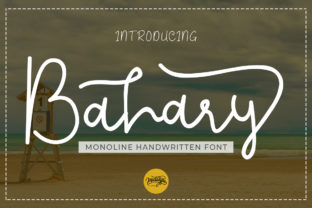
Bahary: A Handwritten Font That Makes Your Brand Feel Luxurious
It started with a stack of blank candle labels on my kitchen table—just me, a printer, and the growing realization that my small-batch soy candles deserved better than the generic script font I’d been using for months. My customers loved the scents, the care in each pour, the handwritten notes tucked into every order—but the labels? They looked like an afterthought. That’s when I discovered Bahary.
Bahary is a Script Handwritten font with real personality: elegant curves, confident strokes, and stylish alternates that give every word a little extra flair. It doesn’t try to be perfect—it feels human, intentional, and quietly luxurious. Not flashy. Not fussy. Just warm, refined, and unmistakably *yours*.
I used Bahary first on my candle jar labels—just the scent names (“Amber & Rain,” “Linen & Lavender”) in clean black ink over cream kraft paper. Instantly, the packaging felt more cohesive, more considered. Then came the thank-you cards, printed on thick cotton stock. With Bahary’s natural flow and subtle alternates, even simple phrases like “Thanks for lighting up my day” carried warmth and sincerity—not just text, but tone.
What makes Bahary especially practical for small business owners is how it works across so many touchpoints—without needing design expertise. You can use it confidently in:
- Logo design (as a primary or secondary mark—especially effective paired with a clean sans serif)
- Product labels and jar tags (great for ingredient lists, scent names, or batch numbers)
- Packaging design, including bakery boxes, skincare pouches, or boutique gift wrap
- Business cards and stationery sets
- Menus at cafés or pop-up food stalls
- Social media graphics—Instagram story headers, Pinterest pins, Reel thumbnails
- Website banners and email headers (when used sparingly and sized appropriately)
- Digital ads and printable flyers for local markets or craft fairs
Typography shapes first impressions faster than most of us realize. When someone sees your product on a shelf—or scrolls past your post in their feed—they’re not reading words first. They’re feeling *mood*, sensing *trust*, noticing *care*. Bahary helps communicate all three—not by shouting, but by leaning in softly. Its handwritten rhythm feels personal, its alternates add quiet sophistication, and its consistency across materials builds recognition without repetition.
Here’s what I learned while testing it: Bahary shines best as a display font. Think headlines, logo lockups, short titles, and decorative accents—not long paragraphs or tiny ingredient footnotes. For readability on small labels or mobile screens, I keep it above 14pt and avoid tight letter spacing. On printed packaging, it holds up beautifully at 18–24pt with generous line height. And for social media, I reserve Bahary for top-line text only—like a banner headline or product name—then pair it with something clean underneath.
My go-to pairing? A light, airy sans serif—think Montserrat Light or Inter Regular. The contrast lets Bahary breathe while grounding the design in clarity and modern simplicity. Sometimes I’ll layer it with a gentle serif for editorial-style posts (like a blog header or newsletter feature), but never another script font—too much movement competes instead of complements.
Before downloading Bahary, I made sure it included everything I needed for real-world use: OpenType features like stylistic alternates and ligatures, multiple file formats (.OTF and .TTF), full commercial licensing (so I could use it on client work, digital templates, and physical products), and basic multilingual support for common European languages. I also checked that the alternates were intuitive—not buried in complex menus—and that the font loaded smoothly on my Canva and Adobe Creative Cloud setups.
One unexpected win? Consistency. Before Bahary, I was juggling three different handwriting fonts across Instagram, packaging, and my website—each with slightly different energy. Switching to one strong, versatile handwritten font unified everything. Customers began mentioning how “cohesive” the brand felt—even though nothing else had changed. Just the typeface.
And yes—it’s a premium font, but not in a way that feels out of reach. It’s priced fairly for what it delivers: professional polish without requiring a designer’s time or a rebrand budget. For a handmade soap maker, a café owner designing seasonal menus, or a coach building course slides, Bahary is the kind of detail that says, “I care about how this feels—not just how it looks.”
If you’ve ever hesitated before hitting “print” because something just didn’t feel *quite right*, you know that moment—the gut sense that your visuals aren’t quite matching your values. Bahary helped me close that gap. It didn’t overhaul my brand. It elevated it—quietly, consistently, and with real heart.
Whether you're printing stickers for your online shop, updating your Etsy banner, or hand-lettering a new menu board, Bahary gives your words weight, warmth, and distinction. It’s not just another script font. It’s the kind of typeface that makes people pause, smile, and remember—not because it shouts, but because it speaks with intention.